China Best Smart Factory Automation What Is Its Role?

Time:2026-09-17 Author:Amelia
0%

China’s smart factory movement is changing how products are made, inspected, and delivered. The International Federation of Robotics (IFR) reported 276,288 industrial robots installed in China during 2023, representing about 51% of global installations. This figure shows strong industrial investment, but robot numbers alone do not define factory intelligence. The shift is visible. A modern production line may combine robotic arms, machine vision, sensors, automated guided vehicles, and manufacturing execution software. These systems can detect a surface defect, adjust a process, and record results within seconds.

So, what is the role of automation in smart factories? Automation connects physical work with real-time data. It can improve repeatability, reduce manual handling, support safer operations, and help engineers identify downtime patterns. Deloitte’s 2023 Smart Manufacturing and Operations Survey found that 86% of surveyed manufacturing leaders considered smart manufacturing important for competitiveness over the next three years. The evidence is encouraging, yet implementation remains uneven. A small factory may still struggle with legacy equipment, poor data quality, limited skills, or expensive system integration. That reality deserves attention. More automation is not always better automation. China’s best smart factories usually combine reliable equipment with trained workers, clear maintenance procedures, cybersecurity controls, and measurable production goals. The strongest results appear when automation supports human judgment instead of simply replacing it. This article examines automation’s practical role, its measurable benefits, and the limitations that manufacturers should consider before expanding a smart factory program.
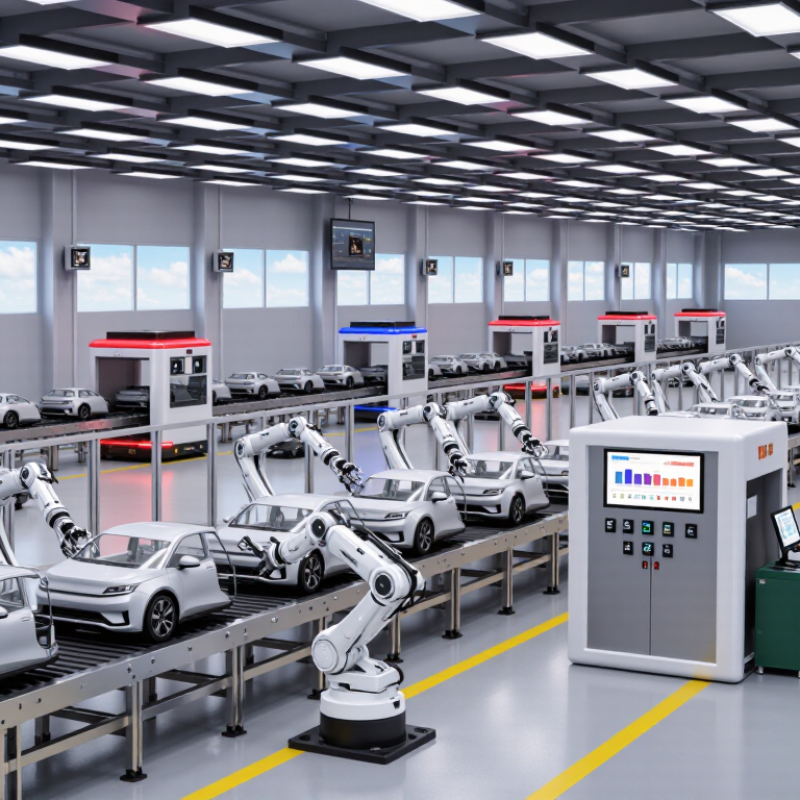
China Best Smart Factory Automation What Is Its Role?

What Is Smart Factory Automation in China?

Smart factory automation in China connects machines, sensors, software, and workers through real-time production data. It is more than installing robots. A typical line may use sensors to monitor motor temperature, a manufacturing execution system to track orders, and analytics to predict maintenance needs. Operators can see an alarm on a tablet before a conveyor stops.

276,288 industrial robot installations in China during 2023.

The International Federation of Robotics reported 276,288 industrial robot installations in China during 2023. That represented about 51% of global installations, according to World Robotics 2024.

These figures show strong investment, but automation alone does not create intelligence. Poor data quality, disconnected equipment, and unclear responsibilities still reduce factory performance. The system may look modern. The process may remain inefficient.

Tips: Start with one measurable problem, such as unplanned downtime or material waste. Collect clean data from existing equipment before adding advanced artificial intelligence. Use secure access controls and regular audits.

The China Academy of Information and Communications Technology has also highlighted data integration and industrial connectivity as key elements of smart manufacturing. In practice, a factory should test whether a dashboard changes decisions, not merely whether it displays attractive charts. Small improvements often reveal larger weaknesses.

How Do Smart Factory Automation Systems Work?

Smart factory automation systems connect machines, sensors, software, and workers through a shared production network.

Sensors measure temperature, vibration, speed, pressure, and material levels in real time. Controllers then interpret these signals and adjust motors, valves, robots, or conveyors.

A production line can slow down when a motor overheats. It can also stop when a safety sensor detects an open guard.

The data usually moves through industrial networks to edge computers or factory management software.

Edge devices process urgent information locally, reducing delays and maintaining control during network interruptions. Management systems track orders, equipment status, energy use, and product quality.

Operators view this information on dashboards and can change approved settings from a control station.

This process supports predictive maintenance, because unusual vibration may reveal a worn bearing before failure.

However, automation is not automatically accurate. Poor sensor placement can create misleading readings. Dust, heat, and vibration may also damage measurement quality.

A system can produce false alarms when its limits are configured carelessly. Human experience remains necessary for calibration, inspection, and safe decisions.

In practice, technicians compare digital readings with physical checks, such as listening to a gearbox or examining a finished part.

That feedback improves the system, but not perfectly. Data gaps still happen.

What Technologies Power China’s Smart Factories?

China’s smart factories rely on connected machines, industrial sensors, and real-time production data. Sensors track temperature, vibration, pressure, and energy use across each workshop. Industrial networks send this information to edge computers near the equipment. Faster local processing helps reduce delays when machines need immediate adjustments.

Artificial intelligence supports visual inspection and predictive maintenance. Cameras can detect scratches, missing parts, or incorrect assembly within seconds. Machine-learning models also identify unusual vibration patterns before a motor fails. Autonomous mobile robots move materials between storage areas and production lines. Digital twins simulate workflow changes before engineers alter the physical factory. This can save materials, time, and avoidable downtime.

Cloud platforms connect factory data with planning and quality systems. Private 5G networks may support stable communication among robots, sensors, and control devices. However, technology alone does not create a smart factory. Older equipment often lacks compatible interfaces, and poor data can weaken accurate analysis. Workers still need training to question automated recommendations. A wrong sensor reading can produce a confident but incorrect decision. Cybersecurity, maintenance costs, and data governance also require continuous attention, not one-time installation.

What Role Does Automation Play in Modern Manufacturing?

Automation now acts as the operational backbone of modern manufacturing. Its role extends beyond faster production. It connects machines, workers, materials, and quality data across a production line. A robotic arm may place components with consistent pressure and timing. Meanwhile, sensors check temperature, vibration, and alignment every few seconds. This steady visibility helps teams detect small deviations before they become expensive defects.

Automation also improves workplace safety. Machines can lift heavy parts, handle repetitive movements, and work near controlled temperatures. Workers then focus on setup, inspection, maintenance, and process decisions. That shift requires practical training, not just software installation. An operator must understand alarms, verify measurements, and stop equipment when conditions look unsafe. Good systems keep clear records of machine settings, inspections, and material movement. These records support audits, traceability, and informed maintenance planning.

However, automation is not flawless. A misaligned sensor can repeat the same error thousands of times. I have seen production plans overvalue speed and overlook changeover complexity. That mistake creates idle equipment and frustrated employees. Human judgment still matters when materials vary or customer requirements change. The strongest factories treat automation as a decision-support tool, while people retain control of quality and responsibility. This balance is difficult. It demands honest testing, regular calibration, and willingness to redesign weak processes.

What Role Does Automation Play in Modern Manufacturing?

Annual global installations of industrial robots show how automation supports higher productivity, consistent quality, workplace safety, and flexible production.

Source: International Federation of Robotics, World Robotics reports. Values represent worldwide annual industrial robot installations, in thousands of units.

How Can Businesses Evaluate China’s Automation Solutions?

Businesses evaluating China’s smart factory automation should begin with production facts, not impressive demonstrations. Define the target process, daily output, defect rate, product mix, and acceptable downtime. Ask how the system performs during model changes, material shortages, and network interruptions.

Request a live factory visit or an independently verified test report. Ask for evidence. Check cycle-time records, maintenance logs, safety certifications, and software update procedures. The solution should communicate with existing equipment through documented interfaces. Confirm compliance with relevant local and international safety requirements. A polished demo is not proof. Run a pilot.

Cost evaluation must include installation, training, spare parts, energy use, cybersecurity controls, and five-year maintenance. Compare the total cost of ownership, not only the equipment quotation. Ask whether technicians can diagnose faults remotely and how quickly replacement parts arrive. Clear service-level agreements matter, especially when production runs continuously.

Reference checks should involve factories with similar materials, volumes, and working conditions. Speak with operators, not only sales representatives. Their comments may reveal difficult cleaning routines, confusing screens, or frequent sensor adjustments. Numbers can mislead. A high automation rate may still create bottlenecks elsewhere. Leave room for manual intervention, gradual upgrades, and honest review after the pilot.

China Best Smart Factory Automation What Is Its Role? - How Can Businesses Evaluate China’s Automation Solutions?

Evaluation Dimension Role in Smart Factory Automation Key KPI or Data Point Calculation or Evaluation Method Suggested Acceptance Reference Required Evidence
Production Efficiency Automation coordinates machines, material handling, inspection, and production scheduling to reduce manual delays. Overall Equipment Effectiveness (OEE) OEE = Availability × Performance × Quality Set a project-specific baseline and improvement target; avoid comparing OEE without using the same downtime and quality definitions. Baseline data, machine-cycle records, downtime codes, quality records, and acceptance-test results.
Capacity and Cycle Time Determines whether the proposed system can meet demand without creating bottlenecks. Cycle time, takt time, throughput, and buffer capacity Takt time = Available production time ÷ Required quantity Validated cycle time should be equal to or shorter than takt time under the agreed product mix and operating conditions. Time-study report, product-mix simulation, stress test, and continuous-production demonstration.
Quality Performance Machine vision, sensors, traceability, and automated process control help prevent and identify defects. First-pass yield, defect rate, false-rejection rate, and measurement repeatability First-pass yield = Accepted units before rework ÷ Total units produced Acceptance limits must be based on product specifications, gauge capability, and the agreed sampling plan. Inspection-system validation, gauge repeatability and reproducibility study, defect images, and traceability records.
Flexibility and Scalability Allows the factory to support product variants, changing volumes, and future production cells. Changeover time, supported product variants, recipe-management capacity, and expansion interfaces Changeover time = Time from final good unit of Product A to first approved unit of Product B Demonstrate the agreed number of variants and complete at least one controlled changeover during acceptance testing. Changeover records, configuration-management procedures, spare I/O capacity, and expansion drawings.
System Integration Connects machines, programmable logic controllers, manufacturing execution systems, warehouse systems, and enterprise applications. Data completeness, interface reliability, protocol compatibility, and synchronization latency Measure successful message transactions, missing records, timestamp accuracy, and end-to-end response time. Prefer documented, standards-based interfaces such as OPC UA, MQTT, REST APIs, or industrial Ethernet protocols where appropriate. Interface-control document, data dictionary, protocol test results, API documentation, and fault-recovery test.
Safety Compliance Protects operators and maintenance personnel from hazards caused by robots, machinery, energy sources, and automated movement. Risk assessment, safety functions, stopping performance, guarding, and emergency-stop response Verify the required Performance Level or Safety Integrity Level for each safety-related control function. Use applicable requirements from ISO 10218, ISO 13849-1, IEC 62061, and ISO/TS 15066 where relevant. Signed risk assessment, safety-circuit validation, safeguarding layout, training records, and compliance documentation.
Cybersecurity Reduces the risk of unauthorized access, production disruption, data loss, and unsafe control changes. Asset inventory, account control, patch process, network segmentation, backup recovery, and security-event logging Assess controls against the applicable industrial cybersecurity architecture and risk level. Use IEC 62443 principles, least-privilege access, unique user accounts, controlled remote access, and tested backups. Cybersecurity risk assessment, network diagram, access-control list, vulnerability-management plan, and recovery test report.
Reliability and Maintainability Ensures that automated equipment remains available and can be repaired quickly. Mean Time Between Failures (MTBF), Mean Time To Repair (MTTR), spare-parts availability, and preventive-maintenance compliance MTBF = Operating time ÷ Number of failures; MTTR = Repair time ÷ Number of repairs Use historical or pilot data; do not accept unsupported reliability claims without test conditions and failure definitions. Reliability test data, maintenance schedule, spare-parts list, diagnostic functions, and service-response procedure.
Energy and Resource Efficiency Monitors energy use and supports lower operating costs and environmental performance. Energy intensity, compressed-air consumption, idle power, and peak demand Energy intensity = Total energy consumed ÷ Good units produced Compare the automated solution with the verified baseline under equivalent production volume and product mix. Submetering plan, energy baseline, operating profiles, compressed-air test, and energy-saving calculation.
Total Cost of Ownership Shows whether the solution creates financial value beyond the initial purchase price. Capital expenditure, installation cost, training, software fees, maintenance, energy, labor impact, and downtime cost TCO = Initial investment + Operating costs + Maintenance costs + Upgrade costs − Residual value Evaluate payback and sensitivity under conservative, expected, and adverse production scenarios. Itemized quotation, five-year cost model, assumptions, warranty terms, software-license terms, and sensitivity analysis.
Implementation Capability Determines whether the supplier can convert the design into a stable production system within the required schedule. Milestone completion, commissioning duration, training hours, open issues, and ramp-up performance Track planned versus actual dates and classify issues by severity, owner, and closure time. Require a documented FAT, SAT, operator training plan, ramp-up plan, and handover checklist. Project schedule, responsibility matrix, factory-acceptance records, site-acceptance records, and training certificates.
Localization and Service Support Reduces downtime and improves communication, maintenance, documentation, and spare-parts access in the operating region. Response time, resolution time, local service coverage, spare-parts lead time, and documentation language Measure service performance against contractual service-level targets and actual support records. Define response and resolution targets before purchase; separate remote support from on-site support. Service-level agreement, escalation matrix, spare-parts inventory, manuals, remote-support controls, and maintenance training.
Data Ownership and Governance Ensures that production, quality, maintenance, and energy data remain accessible, accurate, and usable throughout the system life cycle. Data ownership, retention period, export format, timestamp accuracy, audit trail, and backup frequency Verify that authorized users can export complete and readable data without depending on undocumented proprietary tools. Contractually define ownership, access rights, retention, portability, cybersecurity responsibilities, and exit procedures. Data-governance agreement, database schema, export demonstration, audit logs, backup test, and access-rights matrix.
Pilot Validation and Acceptance Confirms that the solution performs under actual materials, operators, product variants, and factory conditions. FAT pass rate, SAT pass rate, agreed availability, throughput, quality, safety, and data-integrity results Use a written protocol with test duration, operating conditions, measurement methods, tolerances, and corrective-action rules. Approve the system only after all critical safety, quality, performance, documentation, and training requirements are closed. FAT and SAT protocols, signed test records, issue log, final as-built drawings, software backup, and formal acceptance certificate.
Evaluation note: Acceptance thresholds should be finalized according to the product, process, factory environment, applicable regulations, and agreed contract conditions. Reference frameworks include ISO 10218, ISO/TS 15066, ISO 13849-1, IEC 62061, IEC 62443, IEC 62541, and ISO 50001 where applicable.

FAQS

How do smart factory automation systems coordinate production equipment?

Sensors measure temperature, vibration, pressure, speed, and material levels in real time. Controllers adjust motors, valves, robots, or conveyors. A line may slow when a motor overheats.

What happens when a safety sensor detects danger?

The system can stop affected equipment when a guard opens. This protects workers and limits additional damage. Human checks still matter.

Why are edge computers useful in factories?

Edge computers process urgent data near the machines. They reduce delays and maintain local control during network interruptions. That is useful.

How does artificial intelligence support factory operations?

Cameras can identify scratches, missing parts, or incorrect assembly within seconds. Machine-learning models can flag unusual motor vibration before failure. Predictions can still be wrong.

Can digital twins improve production planning?

Digital twins simulate workflow changes before engineers modify the physical line. They may reduce wasted materials and avoidable downtime. The simulation is not reality.

How should a business evaluate an automation solution?

Start with daily output, defect rates, product mix, and acceptable downtime. Request a live factory visit or independently verified test report. A polished demonstration proves little.

What costs should businesses include?

Consider installation, training, spare parts, energy, cybersecurity, and five-year maintenance. Compare total ownership costs with the equipment quotation. Cheap equipment may become expensive later.

Why are operators and technicians still necessary?

Workers calibrate sensors, inspect equipment, and question automated recommendations. They may compare readings with a gearbox’s sound or a finished part. Human judgment is imperfect too, but necessary.

Conclusion

China’s smart factory automation combines connected machinery, intelligent software, and real-time data to create more efficient, flexible, and responsive manufacturing environments. These systems typically link sensors, robots, production equipment, and management platforms so that factories can monitor operations, identify problems, adjust workflows, and improve quality with less manual intervention. Technologies such as industrial internet networks, artificial intelligence, machine vision, digital twins, cloud computing, and advanced control systems help transform traditional production lines into integrated smart facilities.

A central question is: what is the role of automation in smart factories? Automation performs repetitive or precise tasks, supports safer working conditions, reduces production errors, improves resource utilization, and enables continuous process optimization. However, businesses should evaluate automation solutions carefully by examining compatibility with existing equipment, scalability, cybersecurity, maintenance requirements, workforce training, data management, and long-term cost effectiveness. The best approach is to select solutions that match production goals and can adapt as operational needs change.

Amelia

Amelia

Amelia is a seasoned marketing professional with a wealth of expertise in our company’s core offerings. With an unwavering passion for driving growth and innovation, she plays a pivotal role in shaping our marketing strategies and enhancing brand visibility. A key aspect of her responsibilities......